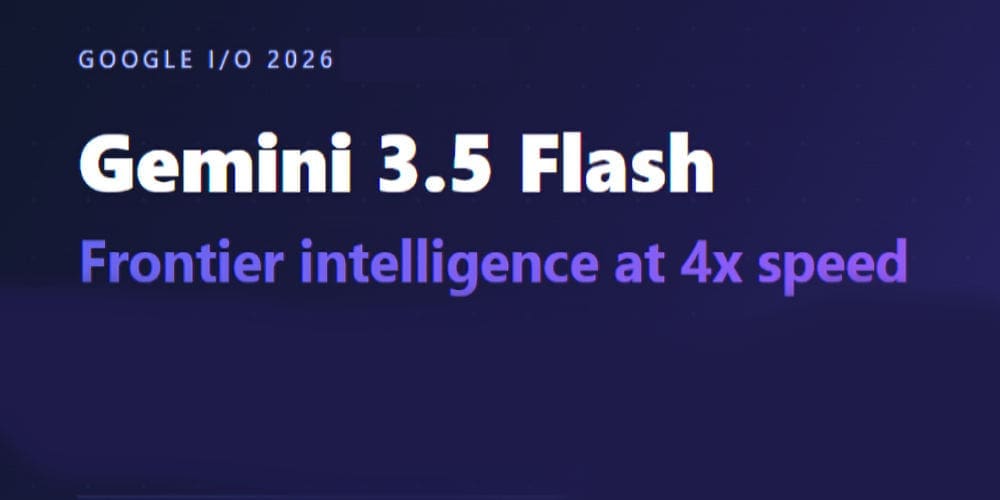

Google Gemini 3.5 Flash: A Faster, Smarter Leap Toward Production-Ready AI
Google has taken a bold step forward in AI development with the release of Gemini 3.5 Flash, a model that skips the traditional preview phase and launches directly into general availability (GA). That decision alone signals confidence. Rather than testing the waters through limited access programs, Google is positioning Gemini 3.5 Flash as ready for real-world deployment from day one.
For developers and businesses, this matters. Production-ready AI often comes with trade-offs between performance, cost, and reliability. Gemini 3.5 Flash aims to strike a balance between all three—offering advanced reasoning, scalable performance, and affordability in one package.
According to Prompt Engineering, one of the model’s standout strengths lies in its enhanced token generation capabilities, allowing it to produce richer, more structured outputs. That makes it particularly valuable for workflows requiring precision, context awareness, and scalable automation.
Why Google’s Direct-to-GA Launch Matters
Traditionally, AI models go through extended preview or beta phases before becoming widely available. These testing periods allow companies to gather feedback, patch issues, and improve stability.
Gemini 3.5 Flash takes a different route.
By moving directly into general availability, Google is effectively signaling that the model is mature enough for enterprise-grade applications. It’s a notable shift in deployment strategy and reflects growing confidence in the model’s real-world performance.
For organizations, this means faster adoption and shorter implementation timelines. Teams can integrate Gemini 3.5 Flash into workflows without waiting months for production readiness, accelerating time-to-value while maintaining scalability and cost efficiency.
Bigger Token Generation, Better Output
One of Gemini 3.5 Flash’s biggest improvements is its ability to generate significantly more tokens than previous Flash models.
Why does that matter?
More tokens generally translate to richer, more detailed responses. Whether it’s generating structured reports, handling complex prompts, or producing nuanced outputs, Gemini 3.5 Flash delivers a level of depth that earlier lightweight models struggled to achieve.
In many cases, its performance reportedly approaches that of Gemini 3.1 Pro Preview—particularly when it comes to reasoning quality and contextual output—but at a lower operational cost.
That balance between high-quality output and affordability makes Gemini 3.5 Flash particularly appealing for production environments where efficiency matters as much as capability.
Built for Complex Reasoning and Multi-Agent Workflows
Gemini 3.5 Flash isn’t just faster—it’s smarter in collaborative environments.
The model performs especially well in multi-agent workflows, where several AI systems work together toward a shared goal. This capability is increasingly important for tasks like agentic coding, simulations, and problem-solving systems that require coordination between multiple AI components.
In coding scenarios, Gemini 3.5 Flash can support collaborative development, helping multiple agents reason through technical challenges, debug systems, or build applications more effectively.
Its reasoning strengths also make it useful for simulations and logical workflows that demand adaptability. That said, the model isn’t perfect. Reports suggest it occasionally struggles with what researchers describe as “misguided attention” in modified logical scenarios—an area that may require further refinement over time.
Versatility Across Industries
One of the strongest selling points of Gemini 3.5 Flash is its adaptability.
The model is capable of handling a broad range of applications, including:
- Web development for functional applications and automation
- 3D simulations and visualizations requiring contextual reasoning
- Technical workflows involving coding and structured outputs
- Analytical tasks that benefit from deeper reasoning capabilities
This flexibility makes Gemini 3.5 Flash attractive to businesses operating across creative, technical, and enterprise environments.
Rather than serving as a niche AI tool, it positions itself as a general-purpose model capable of supporting diverse operational needs.
Features That Make Gemini 3.5 Flash Stand Out
Google has introduced several advanced capabilities that expand what developers can accomplish with Gemini 3.5 Flash.
Code Execution
The model can run and test code snippets directly, reducing friction during development and helping teams prototype faster.
Function Calling
Gemini 3.5 Flash supports seamless integration with external systems, enabling more dynamic workflows and allowing applications to interact with APIs and tools in real time.
Adaptive Thinking Levels
Perhaps one of its more intriguing features, the model can adjust token generation depending on task complexity. Simpler tasks remain efficient, while more demanding prompts receive deeper reasoning and expanded outputs.
Together, these capabilities make Gemini 3.5 Flash a flexible tool for both technical teams and semi-technical users building AI-driven systems.
Where Gemini 3.5 Flash Fits in Google’s AI Lineup
Within the broader Gemini ecosystem, Gemini 3.5 Flash appears to occupy a middle ground between affordability and performance.
Compared with Gemini 3 Flash Preview, it generates more detailed and structured responses, though sometimes at slightly slower speeds. Meanwhile, its output quality reportedly aligns closely with Gemini 3.1 Pro Preview, giving users near-Pro-level performance without the higher price tag.
That positioning could make it an attractive choice for companies seeking enterprise-grade capabilities without premium infrastructure costs.
Strengths—And Areas for Improvement
Like any AI model, Gemini 3.5 Flash comes with trade-offs.
Its strengths are clear:
- Strong reasoning capabilities
- Effective multi-agent collaboration
- Enhanced token generation for richer outputs
- Advanced developer features such as function calling and code execution
- Competitive cost-to-performance ratio
However, some limitations remain. The model can struggle with unconventional logic problems or modified reasoning tasks, occasionally producing inconsistent results in edge cases.
These challenges aren’t unique to Gemini, but improving reliability in high-stakes reasoning environments will likely be a priority for future iterations.
Pricing and Accessibility
Google has yet to share full pricing details or benchmark data for Gemini 3.5 Flash. However, expectations point toward a more affordable alternative to Pro-tier models.
If that pricing strategy holds, Gemini 3.5 Flash could significantly lower barriers to adoption for startups, enterprises, and independent developers alike.
The direct-to-GA launch reinforces Google’s broader goal: delivering scalable AI solutions that are practical enough for widespread production use.
The Bigger Picture
Gemini 3.5 Flash represents more than just another AI model release—it reflects a broader shift in how AI products are delivered and deployed.
By prioritizing production readiness, cost efficiency, and advanced capabilities in a single offering, Google is moving closer to making enterprise-grade AI accessible at scale.
While there’s still room for refinement, particularly in unconventional reasoning scenarios, Gemini 3.5 Flash offers a compelling glimpse into the next generation of AI systems: faster to deploy, smarter in execution, and built with real-world workflows in mind.
For developers, businesses, and AI enthusiasts, it may be one of Google’s most practical releases yet.


